
Why Balcony Gardening Fails So Often in the First Year — A Systems Explanation
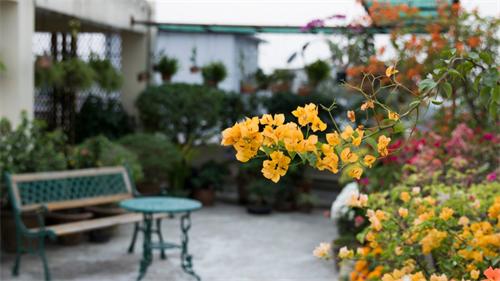
——Most balcony gardening projects fail long before the first seed is planted.
By Oliver Hayes | Updated on January, 2026 | 🕓 10 min read
Key Highlights
- Why do balcony gardens fail even when gardeners follow common advice?
- What makes a balcony fundamentally different from a traditional garden?
- How do sunlight, airflow, temperature, and container size interact in urban growing spaces?
- What does “minimum necessary intervention” mean in practice?
- How can gardeners build a personalized balcony microclimate model?
- Why do identical plants behave differently on different parts of the same balcony?
Three months into what was supposed to be a “simple” balcony garden, the signs of collapse usually begin to appear.
Basil stems turn black near the soil line.
Tomato plants grow taller and taller but never set fruit.
Containers that looked dry yesterday suddenly smell sour after rain.
A jasmine vine produces leaves endlessly, but not a single flower.
Most beginners assume they lack discipline, knowledge, or a natural “green thumb.”
In reality, many balcony gardens fail because they are treated like miniature outdoor farms instead of what they really are: fragile, closed micro-systems with very little room for error.
This may sound harsh, but it is rarely an exaggeration. The withered herbs, leggy tomatoes, and jasmine plants that never bloom are not usually casualties of laziness or impatience. The real problem is more fundamental: we are using the wrong mental model to manage an entirely different kind of system.
We are taught to imagine balconies as miniature pastoral landscapes—some soil, a few seeds, regular watering, and nature will do the rest. Reality is less romantic. A balcony is not a scaled-down version of a field or garden. It is a highly artificial, low-redundancy, enclosed micro-system where mistakes are amplified rather than absorbed.
Failure, in this context, is not accidental. It is structural.
1. Environmental Model Mismatch: A Balcony Is Not a Small Farm
Most gardening knowledge is built on assumptions drawn from open natural systems: unobstructed sunlight, deep and continuous soil layers, natural wind circulation, and ecological redundancy that buffers mistakes.
A balcony is the opposite.
It is bounded by walls and buildings, its sunlight fragmented and filtered, its airflow distorted or blocked entirely, and its soil volume limited to containers. The difference is not one of scale—it is one of system properties.
On many urban balconies, the environment changes more dramatically than beginners realize.
A concrete wall that feels pleasantly warm at sunset may continue radiating heat deep into the night, keeping roots stressed long after air temperatures fall.
In winter, containers near metal railings can feel several degrees colder than areas closer to the building wall.
Even two pots placed less than a meter apart may dry at completely different speeds because of reflected sunlight or hidden wind channels between buildings.
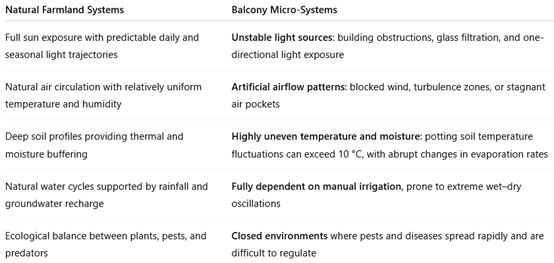
This mismatch produces predictable outcomes:
- Following the advice “water once a day” may cause root rot in summer due to waterlogging, or cold damage in winter due to persistently wet soil
- Plants labeled “full sun” may never flower on a balcony that receives only partial, obstructed sunlight
- Dense planting methods borrowed from open gardens often trigger fungal disease in poorly ventilated balcony environments
A beginner may water faithfully every morning because the soil surface looks dry by noon.
But two inches below, the container can remain cold, dense, and swamp-like for days—especially after humid weather or summer storms.
By the time yellow leaves appear, the roots may already be suffocating.
This is why balcony gardeners often experience a strange contradiction: plants can appear lush for several weeks, then suddenly collapse after a humid stretch of weather with poor airflow.
When balcony gardens fail, it is not because the gardener made careless mistakes. It is because they were given the wrong map. Navigating a closed system with rules designed for open systems almost guarantees disorientation.
2. From Imitating Results to Managing Variables
Popular gardening content—especially short videos and quick-start guides—teaches ritualized actions, not systems thinking:
What soil to buy.
When to sow.
How often to water.
Which fertilizer to apply each week.
This is “cookbook gardening”: follow the steps and expect consistent results. But balcony gardening does not reward procedural obedience. It demands variable management.
This is why many beginners become trapped in strange cycles:
The mint looks weak, so they add fertilizer.
The leaves curl, so they water more.
Fungus gnats appear, so they replace the soil.
Then the plant declines even faster.
Each action feels reasonable in isolation. Together, they destabilize an already fragile system.
Consider the contrast:
- Mainstream advice: “I want to grow tomatoes → water when dry → fertilize weekly according to the calendar.”
- Reality: How long does sunlight actually reach this spot? How stable is temperature? How fast does moisture evaporate? How much airflow exists?
In balcony systems, the real hierarchy of variables is usually:
Light duration and intensity > temperature stability > airflow quality > transpiration rate > root space
On balconies, light often behaves unpredictably.
A spot that receives bright sunlight in spring may fall into complete shadow once nearby trees leaf out in summer.
Afternoon heat reflected from glass windows can suddenly scorch leaves that seemed healthy for weeks.
Meanwhile, a light breeze that feels comfortable to humans may double the drying speed of small containers.
Water and fertilizer—often treated as primary levers—are actually among the highest-risk variables in confined systems:
- High heat + high humidity → root rot
- Low temperature + moisture → cold injury
- Small pots + large leaf mass → rapid dehydration
- Excess fertilizer → salt accumulation, pH shifts, microbial imbalance
A balcony punishes excess faster than neglect.
The first year of balcony gardening should not be a production year. It should be a diagnostic year.
3. The Real Task of Year One: Building Your Balcony Model
Skipping environmental modeling and chasing harvests is like performing surgery without learning anatomy. You might succeed once, but failure is far more likely—and learning from it nearly impossible.
The real work of the first year involves three priorities.
1. Build an Environmental Model
- Map sunlight across seasons: full sun, partial sun, full shade
- Record temperature extremes: summer highs, winter lows, day–night variation
- Observe airflow: where air circulates freely and where it stagnates
Experienced balcony gardeners often remember the exact moment they began paying attention differently.
Noticing which corner stays damp after rain.
Realizing the west-facing wall still radiates heat at midnight.
Seeing one container dry completely while another remains heavy and cool beside it.
The balcony stops looking like decoration and starts behaving like an ecosystem.
2. Run Low-Cost Experiments
- Place the same plant in different locations and compare growth
- Test soil drying time under different watering schedules
- Log pest or disease outbreaks alongside weather and environmental conditions
3. Learn to Read Feedback
In closed, low-redundancy systems, plant responses are the most honest data source you have.
Containers that feel lightweight by afternoon, leaves curling only during windy days, or soil remaining cool and damp long after watering are all forms of environmental feedback.
Most plants fail gradually before they fail visibly.
4. Rethinking Failure: Death Is Data, Not a Verdict
Mainstream gardening culture frames plant death as personal failure. The myth of “green thumbs” and “black thumbs” thrives on this simplification. But in balcony environments—where buffering is minimal—plant death is often nothing more than a system log entry.
Sometimes the signs arrive slowly:
Pale lower leaves.
Stems that suddenly soften.
Soil that smells faintly fermented.
Tiny insects hovering near drainage holes.
Other times, collapse happens overnight after a heat wave or several days of rain.
In small systems, decline accelerates quickly once critical thresholds are crossed.
A healthy diagnostic loop looks like this:
Plant stress or death → variable exceeded tolerance → identify variable → adjust system parameters
What beginners often experience instead is:
Plant dies → self-blame → buy more products → increase system complexity → higher failure probability
Even more counterintuitive:
If nothing dies in your first year, you should be cautious.
That usually signals extreme luck or overly conservative behavior—never truly testing the system’s limits.
Symptoms rarely map to a single cause:
- Yellow leaves may indicate root rot or nitrogen deficiency
- Leggy growth may result from low light or excessive nitrogen
- Failure to flower may stem from insufficient light or nutrient imbalance
The mindset shift is crucial: from “I failed again” to “the system taught me something.”
5. Why Doing More Often Makes Things Worse
A balcony is a simple system with low redundancy. Every additional product—special soils, multiple fertilizers, growth enhancers, pesticides—adds another layer of interaction.
A common downward spiral looks like this:
Slow growth → add fertilizer → leaf burn → replace soil + add more fertilizer → pH and salt imbalance → pesticide harms beneficial microbes → system collapse
The balcony gradually fills with half-used bottles, moisture meters, plant tonics, pest sprays, and bags of specialty soil.
Leaves develop brown edges.
The soil surface hardens into a crust.
Water either drains instantly or refuses to drain at all.
At some point, the gardener is no longer responding to the plant. They are reacting to panic.
At the end, both the gardener and the plants are exhausted—and no one knows what went wrong.
The greatest enemy of balcony gardening is not laziness. It is indiscriminate diligence.
True system management follows the principle of minimum necessary intervention:
- Observe natural drying rates before setting watering schedules
- Assess existing soil fertility before adding nutrients
- Improve light and airflow before reaching for chemicals
Most beginner gardeners are not under-watering plants. They are over-managing systems they do not yet understand.
6. Redefining “Success” in the First Year
If success is measured by yield alone, failure is almost guaranteed.
A more meaningful framework looks like this:
Early Success: Understanding the Environment
- You can sketch seasonal light patterns on your balcony
- You know which weather combinations cause the most plant stress
- You can predict how long soil stays moist after watering
Intermediate Success: Understanding Interactions
- When problems arise, you can list and prioritize multiple plausible causes
- You know which pests or diseases emerge in which months
- You can explain why identical plants behave differently in different spots
Advanced Success: Predictive Capability
- You anticipate plant stress using weather forecasts
- You develop personalized plant–location matching strategies
- You plan rotations and combinations using microclimate differences
The true first-year checklist should include:
- A continuous observation log
- At least one complete life-cycle observation (success or failure)
- Diagnosing at least one pest or disease event
- A detailed balcony microclimate map
- A clear “do-not-do” list of advice that does not work in your system
Your healthiest-looking balcony may actually be your least informative one.
Without experimentation, stress, or failure, it is difficult to understand where the system’s limits actually are.
Conclusion: From Task Executor to System Observer
The high failure rate of balcony gardening exists because we are taught to focus on plants rather than systems; to perform actions rather than observe patterns; to expect results without understanding mechanisms.
Eventually, experienced balcony gardeners stop asking:
“What product should I buy?”
They start asking:
Why does this corner stay humid after sunset?
Why do the leaves wilt only on windy days?
Why does one container remain cool while another overheats?
This is the real transition: from task executor to system observer.
A balcony never becomes fully predictable.
Concrete stores heat.
Wind changes direction between buildings.
Sunlight shifts across seasons.
Containers dry unevenly.
But over time, the environment begins to feel less chaotic.
Not because the system becomes simpler, but because the gardener learns how to read it.
The real success of the first year arrives when you no longer see your balcony as a collection of needy plants, but as a dynamic living system you are beginning to understand.
Those “failed” first years—wilted herbs, stretched tomatoes, jasmine that never bloomed—are not meaningless losses.
If you listen closely, they all say the same thing:
Learn the language of your balcony before trying to write poetry with it.
FAQs
1. Why do balcony plants die faster than garden plants?
Balcony plants exist in confined container systems with limited buffering capacity. Heat, moisture, and nutrient imbalances affect roots much faster than in open ground soil.
2. How long does it take to understand a balcony microclimate?
Usually at least one full seasonal cycle. Sun angles, airflow, reflected heat, and drying patterns change throughout the year.
3. Should beginners use lots of gardening products?
Usually not. Adding too many fertilizers, pest treatments, and specialty products early on often increases instability before the gardener understands the environment itself.
References
1. Bunt, A. C. (2012). Media and mixes for container-grown plants (2nd ed.). Springer.
2. Gruda, N. (2019). Increasing sustainability of growing media constituents and stand-alone substrates in soilless culture systems. Agronomy, 9(6), 298. [https://doi.org/10.3390/agronomy9060298]
3. Poorter, H., Niklas, K. J., Reich, P. B., Oleksyn, J., Poot, P., & Mommer, L. (2012). Biomass allocation to leaves, stems and roots: Meta-analyses of interspecific variation and environmental control. New Phytologist, 193(1), 30–50.
4. Taiz, L., Zeiger, E., Møller, I. M., & Murphy, A. (2015). Plant physiology and development (6th ed.). Sinauer Associates.
5. Whittinghill, L. J., & Rowe, D. B. (2012). The role of green roof technology in urban agriculture. Renewable Agriculture and Food Systems, 27(4), 314–322.
About the Author
Oliver Hayes, MSc – Urban Gardening Systems Researcher & Sustainable Home Writer
Oliver Hayes is a researcher and content writer specializing in urban gardening ecology, balcony food systems, and sustainable home environments. He holds a Master’s degree in Environmental Horticulture from the University of Copenhagen and has collaborated with community garden networks, indoor farming startups, and ecological design organizations across Europe. His work focuses on helping everyday households better understand the hidden environmental factors affecting plant health, indoor biodiversity, and long-term sustainable living practices.
Editorial Transparency Statement
This article is intended for educational and informational purposes only. It combines published research in plant physiology, urban ecology, and container gardening with practical observations from real-world urban growing environments.
The editorial approach prioritizes systems thinking and evidence-based environmental understanding rather than product promotion or trend-driven gardening advice. No commercial sponsorship influenced the content of this article.
Disclaimer
Gardening outcomes vary significantly depending on climate, balcony orientation, local weather patterns, building materials, plant species, soil composition, and maintenance practices.
The information provided in this article should not be interpreted as guaranteed horticultural results. Readers should adapt recommendations to their own environmental conditions and consult qualified horticultural professionals for advanced cultivation issues, toxic plant concerns, or structural safety considerations.
Recommend for you:
Wind, Dust, and the Urban Heat Island Effect: The Three Overlooked Killers of City Balconies
Severely Underestimated Variables in Urban Gardening: Nighttime Temperature Fluctuations
Why I Stopped Choosing “Luxury-Looking” Materials
How Real-Life Wear and Daily Use Taught Me That Beauty Doesn’t Always Equal Comfort
Before You Buy: How Small Observations Can Transform Your Home
7 Days of Observation and Simple Habits to Make Every Corner Work for You
The “Invisible Hazards” in Your Home: It’s Not Just Formaldehyde
The “Invisible Hazards” in Your Home: It’s Not Just Formaldehyde