The “Invisible Hazards” in Your Home: It’s Not Just Formaldehyde
—Why the Factors That Truly Affect Long-Term Health Often Don’t Appear on Test Reports
By Nathaniel Brooks | Updated on March 2026 | 🕓 9 minutes
Key Highlights
- What are “invisible hazards” in the home beyond formaldehyde?
- How do daily habits and long-term cumulative exposures influence health risks?
- Why can “safe” products create systemic risks when combined in real-life scenarios?
- What practical framework can homeowners use to assess risks beyond testing numbers?
Whenever we discuss home safety, one word almost immediately comes to mind: formaldehyde.
Is a newly renovated home safe? Check the formaldehyde.
Can children or pregnant women move in? Check the formaldehyde.
This chemical has become the familiar “villain” in our collective imagination of indoor risks. Testing devices focus on it. Popular science articles explain it. Air purifiers and chemical-removal products are marketed around it.
This intense focus is not entirely unjustified. Formaldehyde indeed poses clear health risks and is irritating to the respiratory system. It is also one of the easiest indoor pollutants to quantify, regulate, and communicate about.
However, does this fixation inadvertently blind us to a wider and more complex landscape of risk? When all attention is centered on a single, measurable indicator, the factors that truly influence long-term living quality are often systemically overlooked.
The greatest risks we face are rarely a single labeled “toxic” substance. They arise from a complex interplay of multiple factors—a phenomenon that can be described as systemic misalignment.
Why Are We So Dependent on the “Formaldehyde Narrative”?
Formaldehyde has become a lightning rod for public attention for very human reasons. It fits several cognitive biases regarding risk perception. First, it is a concrete chemical with a name, a molecular formula, national standards, and devices that give us a number—either reassuring or alarming. Its concentration peaks during the first few months to a year or two after renovation, giving the illusion that “once this period passes, it’s safe.”

This encourages a simple cause-and-effect thinking pattern:
“The house has a ‘bad substance’ (formaldehyde) → remove it → the house is safe.”
But a living environment is not a single-variable system. The true factors affecting health are usually not one-time exceedances; they are chronic, low-intensity, long-term environmental pressures. They are not “invaders” but rather the friction and wear that arise when system parameters are out of balance.
What “Invisible” Really Means
In the context of home environments, “invisible hazards” are often interpreted as substances that are odorless, undetectable, but toxic.
More precisely, invisible means that the hazard does not produce immediate feedback, does not come from a single source, and is highly intertwined with daily habits. Its effects are slow, cumulative, and delayed, making them difficult to detect. You won’t immediately tear up, cough, or feel dizzy. Its influence is gentle but persistent, often manifesting only after months or years.
There is no instrument called a “lifestyle risk detector.” These risks emerge from the interaction of multiple factors: products, spaces, humans, and habits. Whether a risk is “activated” depends on how you use, maintain, and combine elements in your home.
How Risks Quietly Grow in the System
1. Behavioral Use Risks — The Case of Kitchen Oil Fumes
The risk is often not the material itself but how it is used. Many home materials pass static lab tests, but real-life usage deviates from controlled conditions. Lab reports can answer “Is the material compliant?” but cannot answer “Is the usage scenario safe?”
Take cooking as an example. When oils and foods are heated to high temperatures, they generate smoke containing PM2.5 particles and aldehydes/ketones. The problem is not the oil or food itself.
If frying, stir-frying, or searing is done frequently, and the range hood is underpowered or poorly installed, harmful substances can accumulate and spread in indoor air. Neglected filters and aged seals exacerbate this accumulation.
The consequences—long-term inhalation effects on the respiratory system—are invisible, and the risk is often dismissed as “just everyday cooking smells.”
2. Cumulative Exposure Risks — The Case of Composite Flooring and Cleaning
A certified composite floor is generally stable under normal conditions. The issue is rarely the flooring itself.
Repeated cleaning with strong alkaline solutions, solvents, or abrasive tools gradually erodes the protective wear layer, exposing adhesives or base materials beneath. Heated floors accelerate chemical release, while moisture can trigger hydrolysis of some substances. Scratched or worn surfaces become “windows” for potential exposure.
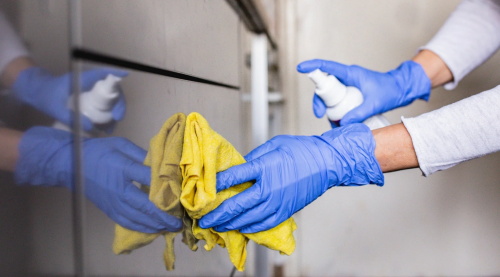
Single cleaning events may appear harmless; wear may seem minimal; emissions may be very low. But over years or even decades, these small stresses accumulate—a “drop-by-drop erosion” effect.
Unlike renovation pollution, these risks lack dramatic spikes, making them invisible in acute-risk monitoring and media narratives.
3. Superimposed Risks — The Case of Scented Products in a Closed Bedroom
A compliant essential oil or air freshener is unlikely to pose a risk in an open room when used according to instructions.
However, consider a nighttime scenario: a bedroom with closed windows and doors, a running diffuser, freshly laundered bedding treated with fabric softener, and recently cleaned floors with volatile cleaning agents. Volatile organic compounds (VOCs) from multiple sources mix in the confined space and remain in contact with a sleeping occupant for up to eight hours.
Even if each substance is below its safety threshold, their combined “cocktail effect” may affect sensitive populations such as children or individuals with allergies.
Here, multiple compliant products plus confined spaces plus extended exposure plus individual sensitivity create a complex risk system.
This is a typical situation where “safe components” together form a “hazardous system.”
Why These Systemic Risks Don’t Make Headlines
1. They cannot be simplified: They cannot be reduced to “one toxic item—throw it out.” Solutions require understanding ventilation, usage patterns, space design, and habits.
2. No immediate stimuli: They do not produce instant, dramatic sensory reactions. There is no “dangerous moment” to photograph or share.
3. They demand reflection: Understanding requires seeing relationships and conditional factors rather than passively accepting a single metric.
They rarely make the news but quietly shape the background of daily life. The quality of managing these low-noise risks profoundly impacts long-term living comfort.
Beyond “Avoiding Hazards”: Learning to Assess
You don’t need to panic-check every home product with a new checklist. Instead, when evaluating an item, habitually ask three questions:
1. Time Dimension: Is this a short-term acute risk, or a long-term, cumulative, or superimposed risk?
2. System Perspective: Is the risk from the material itself, or from the combination of material + usage conditions + environment + habits?
3. Conditional Dependence: Does the risk only manifest under certain lifestyles, usage frequencies, or environmental conditions?
Mastering this framework equips you with a lens to see beyond marketing fear and oversimplified conclusions. It allows you to assess your home as a living ecosystem, making adjustments intelligently rather than chasing a single “villain.”
True safety does not come from endlessly pursuing a single threat. It comes from understanding the logic of how your living system functions and making informed adjustments. By seeing the home as a dynamic system rather than a collection of isolated materials, we can protect long-term health and enhance living quality.
FAQs
1. Can routine cleaning and maintenance gradually increase chemical exposure?
Yes. Many cleaning products contain chemicals that are safe in small, occasional use, but repeated exposure can accumulate over time. For example, using strong alkaline cleaners, solvents, or abrasive tools on composite flooring can gradually erode protective layers, exposing adhesives or underlying materials. Heated floors or moisture can accelerate chemical release, meaning that what seems harmless in a single cleaning session can become a slow, long-term source of indoor pollutants.
2. How does the combination of multiple products in enclosed spaces affect indoor air quality?
Even if each product is individually compliant with safety standards, their combined effect in confined spaces can create “superimposed” risks. For instance, a bedroom with closed windows using a diffuser, fabric softeners, freshly cleaned floors, and other VOC-emitting products can produce a cocktail of chemicals. Prolonged exposure—especially during sleep—may affect sensitive populations, including children or individuals with allergies. The key issue is not the individual product but how multiple sources interact under real-life conditions.
3. What strategies can homeowners use to evaluate long-term environmental risks?
Homeowners can use a systems-based approach to assess risks beyond simple testing:
- Time Dimension: Identify whether the risk is acute (short-term) or chronic and cumulative.
- System Perspective: Consider how materials, usage habits, ventilation, and environmental conditions interact to create potential hazards.
- Conditional Dependence: Evaluate whether the risk only appears under specific lifestyles, usage frequencies, or confined spaces.
This framework allows homeowners to understand their living environment as a dynamic ecosystem and make practical adjustments—such as improving ventilation, moderating chemical use, and monitoring combined exposures—rather than focusing solely on a single measurable chemical like formaldehyde.
References
1. Mo, D., Zhang, H., Wang, Y., et al. Formaldehyde Exposure and Associated Health Burdens Apportioned to Residential and Public Places Based on Personal and Environmental Measurements. Atmosphere, 2025.
2. “Volatile Organic Compounds in Indoor Air: Sampling, Determination, Sources, Health Risk, and Regulatory Insights.” Toxics, 2025.
3. United States Environmental Protection Agency. Introduction to Indoor Air Quality; Indoor Pollutants Can Contribute to Respiratory and Other Chronic Diseases. EPA, [www.epa.gov/indoor-air-quality-iaq/introduction-indoor-air-quality].
4. National Institute of Environmental Health Sciences. Indoor Air Pollution Sources and Health Impacts, Including Cooking and Cleaning. NIEHS, [www.niehs.nih.gov/health/topics/agents/indoor-air].
5. Which? “Cooking Gas Hobs Can Create Indoor Air Pollution Comparable to Busy Roads, Linked to Respiratory Issues.” The Guardian, 7 Mar. 2025, [www.theguardian.com/environment/2025/mar/07/cooking-gas-hob-indoor-air-pollution-uk-road-study].
About the Author
Nathaniel Brooks, BSc – Home Ecology Analyst & Sustainable Living Research Writer
Nathaniel Brooks is a home ecology analyst and independent writer specializing in indoor ecosystems, sustainable household practices, and environmental behavior research. He holds a degree in Environmental Science from the University of Edinburgh and has worked alongside urban agriculture programs, green building consultants, and educational sustainability platforms. His articles combine scientific research with practical observations to help readers create healthier, more resilient homes and gardening spaces.
Editorial Transparency Statement
This article was written based on peer-reviewed research, government publications, and credible industry sources. All interpretations and recommendations are grounded in evidence and current best practices in environmental health. No commercial products were promoted or sponsored in the preparation of this article.
Disclaimer
The content of this article is intended for informational purposes only and does not constitute medical advice. Readers should consult qualified health professionals regarding specific concerns about home safety, indoor air quality, or potential exposure risks.
Recommend for you:

Modern Homes Aren’t Designed for Plants
How Sealed Windows, Open Kitchens, and Central Air Conditioning Subtly Transform Indoor Ecosystems
AI Gardening Assistants: Can Robots Actually Save Your Plants?
The training data for mainstream AI plant diagnosis models mostly comes from “standard healthy samples” or “typical disease samples.”
Solid Wood, Engineered Boards, or Bamboo — What Actually Changes After Five Years of Living With Them
A Long-Term Look at Aging, Maintenance, Repairs, and Real-Life Use — Not a Material Ranking Guide
Why I Stopped Choosing “Luxury-Looking” Materials
How Real-Life Wear and Daily Use Taught Me That Beauty Doesn’t Always Equal Comfort