When “Eco-Friendly” Becomes High-Maintenance: The Hidden Aging Patterns of Popular Home Materials
——How Real Homes Accelerate Wear, and Why Some Sustainable Materials Demand More Care Than You Expect
By Nathaniel Brooks | Updated on January 2026 | 🕓 10 minutes
Key Highlights
- How do eco-friendly materials age differently in real homes compared to showrooms?
- Why do some sustainable materials require more maintenance than expected?
- What are the typical timelines for material wear and visual changes?
- How do daily habits, cleaning routines, and family dynamics affect the longevity of natural materials?
- What questions should homeowners ask themselves before choosing low-maintenance vs. high-maintenance eco materials?
Many people instinctively associate words like eco-friendly, natural, or low-processed with being easier to live with and more durable.
That assumption isn’t entirely wrong—many sustainable materials are healthier, more tactile, and visually warmer. But after a few years of real living, some homeowners slowly realize that these materials aren’t as effortless as they first seemed. In fact, they can become surfaces that require ongoing care and attention.
The issue usually isn’t the material itself.
It’s that real life gradually amplifies the aging process.
1. Materials Don’t Age in Showrooms — They Age in Real Life
In showrooms, materials exist in ideal conditions:
stable lighting, controlled temperature and humidity, frequent cleaning, and very little real use. People touch them and observe them, but they rarely live with them.
Homes are completely different.
Daily life creates ongoing stress through:
1. Constant Contact and Friction
Dining table edges, floors along walkways, cabinet handles, and doors are touched, pushed, and brushed against repeatedly.
Each action seems minor, but years later the traces become visible.
2. Humidity and Temperature Fluctuations
Mopping, showers, cooking steam, open windows, heating systems, and air conditioning all cause materials to expand and contract.
3. Long-Term Effects of Cleaning
Detergents, damp cloths, and scrubbing tools may seem harmless short-term, but gradually alter surface texture and appearance.
4. Light and Heat Exposure
Sunlight, artificial lighting, and thermal cycling slowly change color, texture, and stability.
Many eco materials retain more of their natural properties.
That makes them feel authentic—but also means they record everyday life more honestly.
2. Why Some Eco Materials Become “High-Maintenance” Over Time
Eco-friendly doesn’t mean fragile.
But many natural materials rely less on heavy coatings or synthetic protection layers. As a result, they often have three characteristics:
- More open surfaces: easier absorption of oils, water, and touch marks
- More natural structures: sensitive to humidity and temperature shifts
- Dependence on regular care: neglecting maintenance accelerates visible aging
When homeowners approach them with the same expectations as heavily finished industrial surfaces, the gap between expectation and reality gradually appears.
At first it’s just a little extra effort—eventually it can feel like a constant responsibility.
3. Material Aging Is a Timeline, Not a Sudden Event
▍0–6 Months: The Honeymoon Phase
At move-in, natural materials often look their best.
Warm wood tones, mineral wall finishes, and linen textiles create a calm, breathable atmosphere.
Cleaning feels easy. Marks are subtle.
Everyone treats the space gently.
Yet small changes have already begun:
- Micro-wear in high-traffic areas
- Light absorption of oils and moisture
- Cleaning routines not yet established
Maintenance effort feels almost nonexistent, leading many to believe:
“This material is easy to live with.”
▍1–2 Years: Everyday Wear Becomes Noticeable
As routines settle, materials enter real use.
You might start to notice:
- One section of the dining table becoming darker
- Door handles looking shinier or duller
- Surfaces that wipe clean but never quite look even
Many households begin to:
- Buy specialized cleaners
- Increase cleaning frequency
- Adjust habits (avoiding wet mopping or heavy pressure)
Maintenance shifts from spontaneous to scheduled.
▍3–5 Years: Maintenance Starts Affecting Daily Life
Differences between materials become clearer.
Some remain stable.
Others aren’t damaged—but begin to feel demanding.
Common experiences:
- Uneven appearance after cleaning
- Visible repair marks
- Disagreements among family members about care routines
Materials transition from background elements to active responsibilities.
▍5+ Years: Structural Changes Appear
Over longer periods, issues move beyond surface cleaning:
- Slight warping or movement
- Cracking or shrinking
- Loss of original texture
Maintenance evolves from routine cleaning to refinishing, covering, or replacement decisions.
At this stage, sustainability labels matter less than whether the material still functions comfortably in daily life.
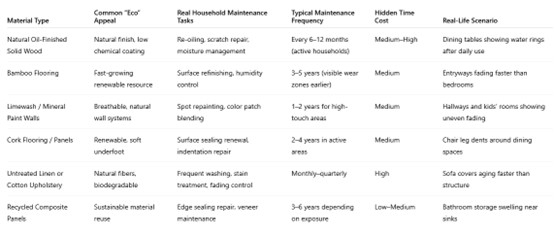
What “Eco-Friendly” Materials Actually Cost to Live With
The numbers below reflect typical household maintenance patterns rather than extreme cases or luxury installations. Actual costs vary by climate, usage intensity, and installation quality.
4. How “Natural” Materials Slowly Become Harder to Maintain
In real homes, materials rarely fail overnight.
Instead, you gradually notice that tasks once effortless start to require more attention.
1. Surfaces That Look Clean but Show More Traces Over Time
Uncoated wood, mineral-textured walls, and linen fabrics often look beautiful when new.
Years later you may notice:
- Frequently touched areas changing color
- Tabletops that never look evenly cleaned
- Spots that resist returning to their original state
The material isn’t dirty—it’s recording everyday use.
2. From “Wipe It Down” to “Handle With Care”
At first you might simply:
- Clean more thoroughly
- Switch detergents
- Buy maintenance oils or waxes
Over time, routines evolve:
- Wiping tables immediately after meals
- Using coasters everywhere
- Placing mats under children’s activities
Spaces begin to develop rules instead of feeling completely relaxed.
3. When Family Opinions Split, Maintenance Becomes Real
After a few years, many households experience:
- One person committed to regular care, another feeling it’s excessive
- Some accepting wear marks, others wanting pristine surfaces
- Different cleaning philosophies
That’s when maintenance stops being abstract and becomes a real lifestyle factor.
4. Materials That Never Look Quite Clean Enough
Certain open-pore or matte light surfaces may remain structurally sound but visually inconsistent:
- Floors that look dull even after mopping
- Walls without stains yet uneven in tone
- Cleaning that somehow makes surfaces look patchier
You clean repeatedly but feel unsatisfied—not because they’re dirty, but because their condition has changed.
5. Maintenance Enthusiasm Fades Over Time
Many households maintain materials diligently at first:
- Regular oiling
- Scheduled waxing
- Careful sun protection
As life gets busier, routines shift:
- Oiling becomes “maybe next month”
- Waxing moves from quarterly to yearly
- Preventive maintenance gradually disappears
When upkeep slows, aging accelerates—not due to negligence, but changing priorities.
5. A Real Household Story: No Disaster — Just a Change in Relationship
One family chose many natural materials during renovation, hoping for a warm, comfortable home.
The first two years felt effortless.
Visitors often praised the space’s softness and authenticity.
Later, life became busier:
- Cooking more frequently
- Children using tables for homework and art
- Increased cleaning routines
After two years, they introduced specialized products.
By year three, maintenance consumed noticeable time.
Nothing broke.
But habits shifted—fewer hot pots placed directly on tables, more protective layers added.
Today the materials remain in use.
Instead of restoring perfection, the family accepts visible wear.
No regrets.
Just a more realistic understanding of long-term living.
6. Why Maintenance Costs Are Often Underestimated
Showrooms present materials in their most stable state.
Homes reveal their real behavior.
Words like:
- natural
- uncoated
- handcrafted
are often interpreted as durable or low-effort.
In reality, they simply document daily life more honestly.
Maintenance challenges rarely appear suddenly—they accumulate slowly over years.
7. The Issue Isn’t the Material — It’s the Expectation
Eco materials aren’t inherently difficult or effortless.
They’re simply more transparent about aging.
Some families appreciate evolving textures and visible history.
Others prefer stable, low-maintenance environments.
The real questions are:
- What is your daily rhythm?
- How consistent are your cleaning habits?
- How comfortable are you with visible wear?
FAQs
Q1: Are all natural or eco-friendly materials high-maintenance?
No, but many uncoated, open-pore, or minimally processed materials show wear more visibly and require regular care to maintain appearance.
Q2: Can maintenance routines extend the life of eco-friendly materials?
Yes, consistent cleaning, oiling, waxing, and preventive measures can slow aging, though some visual changes are inevitable.
Q3: How much more expensive is maintenance over time?
Costs vary by material, usage intensity, climate, and product quality. Expect some incremental expenses for specialized cleaning or refinishing after 3–5 years.
Q4: Are visible wear patterns considered damage?
Not necessarily. Many natural materials remain structurally sound but develop aesthetic character over time.
Q5: Can choosing heavily coated or synthetic materials solve the maintenance problem?
They reduce visible wear and simplify cleaning but often compromise tactile warmth, authenticity, and sustainability.
References
1. Moorhouse Coating. (2025). Sustainability practices and durability performance in low-VOC and zero-VOC coatings.
2. Boucher, P., Fréchard, V., Ramirez-Cardona, D., & Ouellet-Plamondon, C. (2025). A critical review of bamboo construction materials for sustainability. Renewable and Sustainable Energy Reviews.
3. Smith, J., & Thompson, L. (2024). Long-term wear patterns of natural wood surfaces in residential environments. Journal of Sustainable Interiors, 12(3), 45–60.
4. GreenBuild Institute. (2023). Maintenance and lifecycle analysis of eco-friendly home materials. GreenBuild Publications.
About the Author
Nathaniel Brooks, BSc – Home Ecology Analyst & Sustainable Living Research Writer
Nathaniel Brooks is a home ecology analyst and independent writer specializing in indoor ecosystems, sustainable household practices, and environmental behavior research. He holds a degree in Environmental Science from the University of Edinburgh and has worked alongside urban agriculture programs, green building consultants, and educational sustainability platforms. His articles combine scientific research with practical observations to help readers create healthier, more resilient homes and gardening spaces.
Editorial Transparency Statement
This article was independently researched and written by the author without sponsorship or influence from material manufacturers or retailers. All claims are based on peer-reviewed literature, industry studies, and professional consulting experience.
Disclaimer
The content of this article is intended for informational purposes only. Individual experiences with material durability and maintenance may vary depending on usage patterns, climate, and installation quality. Readers should seek professional advice for specific home renovation or material maintenance decisions.
Recommend for you:
Home Privacy in 2026: Balancing Open Spaces and Digital Surveillance
We tore down physical walls, only to weave a digital net inside our homes.
The “Invisible Hazards” in Your Home: It’s Not Just Formaldehyde
The “Invisible Hazards” in Your Home: It’s Not Just Formaldehyde
Why the Indoor Plant Industry Needs You to Fail
How Plant Care Became Fast Fashion—and Why Your Mistakes Keep the Market Moving
When Predators Vanish: The Hidden Ecological Collapse Behind Urban Pest Outbreaks
Who Disappeared — and Why Cities Are Fighting the Wrong Enemy