The Rise of Modular Furniture for Short-Term Urban Living
——The Furniture Dilemma of Urban Nomads: Is Modularity a Solution, or Just Another Compromise?
By Nathaniel Brooks | Updated on May 2026 | 🕓 14 minutes
Key Highlights
- Why do digital nomads prefer portable furniture systems?
- What kinds of modular furniture work best in small apartments?
- Why did furniture subscription companies like Feather struggle?
- When does modular living stop making sense?
- How are shrinking apartments changing furniture design?
- Could open-standard modular furniture become the “USB-C” of home design?
When Jay Reno rented his first apartment in New York in 2015, he did what most people do: he bought a complete set of living room furniture. Three years later, he changed jobs and moved to Brooklyn. The sofa could not fit up the staircase in the new building, so he left it on the curb. Two years after that, he relocated to San Francisco, and his mattress—wrong size for the new bedroom—ended up discarded as well.
By 2023, Jay calculated that over eight years and six moves, he had thrown away more than $4,000 worth of furniture, at least 60% of which had been used for less than two years.
He is not an exception. According to the U.S. Census Bureau Current Population Survey (2022), among the primary reasons Americans move, 14.5% relocate for better housing, while 10.1% move because of job changes. In other words, roughly one out of every four Americans who move does so because they “have to leave.”
Eventually, Jay stopped buying traditional furniture altogether. He became an early user of a furniture subscription company—but we will return to that part of the story later.
Why Now? Cities Are Training Us Not to Put Down Roots
1. The Length of Time People Stay in One Home Is Shrinking
The median homeownership tenure in the United States has increased overall. According to the National Association of Realtors 2023 report, the national median homeowner tenure reached 12.3 years. But this statistic hides a divided reality.
In rapidly growing cities such as Denver, Phoenix, and Las Vegas, average ownership duration is only seven to nine years. In the rental market, cycles are even shorter. Tracking data from the Bureau of Labor Statistics shows that the average lease duration for renters has fallen from around 24 months during the 2010s to approximately 18 months in the 2020s.
Europe tells a similar story. According to Eurostat data released in 2024, young adults in the European Union leave their parents’ homes at an average age of 26.2. But this is not necessarily because they prefer to stay longer. Housing costs are pushing stability further out of reach. Among people aged 15–29, 9.7% spend more than 40% of their disposable income on housing. In Greece, the proportion reaches 30.3%.
Young people do not reject stability. Stability has simply become too expensive.
2. Digital Nomads: People Who Choose Instability on Purpose
According to the 2024 State of Independence in America report by MBO Partners, 18.1 million Americans identified themselves as digital nomads in 2024, an increase of 4.6% from the previous year. More importantly, the number of self-employed digital nomads grew by 20%.
Meanwhile, Nomad List analyzed 320,059 user check-ins and found that Mumbai (+149%), Da Nang (+127%), and Panama City (+114%) became the fastest-growing remote work hubs of 2024.
These individuals typically stay in one city for only three to six months. For them, the very act of “buying furniture” can feel absurd.
3. Apartments Are Getting Smaller
In 2025, Melbourne approved an apartment building whose smallest unit measured only 24.5 square meters (approximately 264 square feet), below the city’s usual 30-square-meter minimum standard.
This is not unique to Australia. From London to Tokyo, from New York to Hong Kong, the median size of newly built apartments has shrunk by roughly 15%–30% over the past decade.
Living spaces are shrinking, people are becoming more mobile, yet furniture remains increasingly bulky. That contradiction is the soil in which modular furniture has grown.
What Exactly Is Modular Furniture? First, Let’s Eliminate Three Misconceptions
Many people assume that any furniture that can be disassembled counts as “modular.” That definition is far too simplistic. I divide modular furniture into three levels:
Level 1: Knock-Down Furniture
This is essentially the disassemblable version of traditional furniture. Yes, you can take it apart and move it, but after disassembly you are left with irregular boards and loose hardware. Reassembling it multiple times often strips screw holes or weakens joints.
Most flat-pack furniture falls into this category.
Level 2: Reconfigurable Furniture
Products such as the IKEA KALLAX shelving system belong here. You can add or remove units and rearrange layouts. However, the material is usually particleboard, and repeated assembly eventually loosens the connectors.
Level 3: Truly Portable Furniture
This is furniture genuinely designed for urban nomads.
Take the USM Haller system as an example. Its steel tube framework and metal panels are connected through spherical joints. A bookshelf can be transformed into bedside tables, then rebuilt into a desk. Individual modules are light enough for one adult to carry independently.
But there is a harsh reality here: a basic USM Haller module can cost roughly $500–$800.
Modularity does not mean affordability.
According to the Global Modular Furniture Market Analysis 2024 by Cognitive Market Research, the global modular furniture market reached approximately $73.25 billion in 2024, with North America accounting for more than 40% of the market. The Asia-Pacific region is growing fastest, with a CAGR of 7.0%.
The driving forces are not low prices, but space efficiency and customization.
In other words, modular furniture solves the problem of flexibility, not the problem of cost. If you assume modular sofas are automatically cheaper than buying new ones, you will probably be disappointed.
Practical Guide: How to Design a “Take-It-With-You” Home
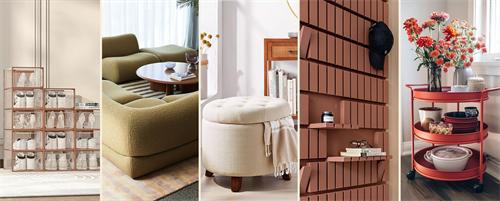
Living Room: Abandon the Fixed “Sofa + Coffee Table” Formula
The Traditional Trap
A three-seat sofa, a heavy wooden coffee table, and a TV cabinet. During a move, the sofa may not fit into the elevator, the tabletop may not detach, and the TV cabinet dimensions may not match the next apartment.
Modular Alternatives
- Compressible Modular Sofas
Some products use vacuum-compression technology that reduces each sofa module to roughly 20% of its original volume. By 2026, several brands had begun using this approach to reduce shipping size. During a move, modules can fit into the back seat of a standard car.
- Lift-Top Coffee Tables
Raised to 75 cm during the day, they function as standing desks. Lowered to 45 cm at night, they become dining tables. Many include wheels and hidden storage underneath.
- Pitfall Warning
Avoid sectional sofas with permanently attached chaise lounges. That L-shaped corner becomes a spatial disaster in most new apartments.
Bedroom: The Bed Should Be a Space Transformer, Not Just Furniture
Case Study: A 24.5-Square-Meter Apartment in Melbourne
In 2025, a Melbourne designer renovated a legally approved 24.5-square-meter micro-apartment. His core principle was simple:
Every piece of floor furniture must be able to “disappear.”
- Murphy Beds
When folded away, the entire floor area becomes usable. However, Murphy beds usually require wall mounting. After moving out, tenants may face security deposit deductions because of drill holes and wall damage. This is one of the gray areas of modular living.
- Storage Bed Frames
Hydraulic lifts raise the mattress platform, creating hidden storage space underneath for seasonal clothing and reducing the need for separate wardrobes.
- Modular Wardrobes
Instead of traditional closets, the design used open metal frames combined with standardized storage boxes. During a move, the frame is dismantled while the boxes are packed directly into shipping cartons.
Workspace: Walls and Rolling Carts Are Your Allies
- Fold-Down Wall Desks
When not in use, these desks fold flat against the wall with a thickness of less than 15 cm. But once again, wall mounting introduces repair costs if you move every six months.
- Utility Carts
Rolling carts can function as side tables, filing cabinets, or plant stands. Products inspired by the RÅVAROR concept are designed to be movable by one person. However, lightweight metal carts can tip over when unloaded, which may create safety concerns for households with pets or children.
A Failed Experiment: Modular Living in a London Shared Apartment
In 2023, a renter in London shared his “fully modular living experiment” on Reddit’s r/minimalism community.
He used modular shelving as room dividers, folding tables as dining surfaces, and inflatable sofas as living room seating.
Three months later, his conclusion was blunt:
“Modular furniture is always about 10%–15% worse than specialized furniture in terms of function. Folding tables are less stable than solid wood tables. Inflatable sofas provide weaker support than foam sofas. If you plan to stay somewhere longer than two years, the compromise may not be worth it.”
This story does not have a happy ending, but it raises an important question:
Modularity is a trade-off, not an upgrade.
The Truth About Costs — and the Illusion of Sustainability
1. Five-Year Total Cost of Ownership (TCO)
Imagine renting in one city for three years, then relocating to another city for two more years.
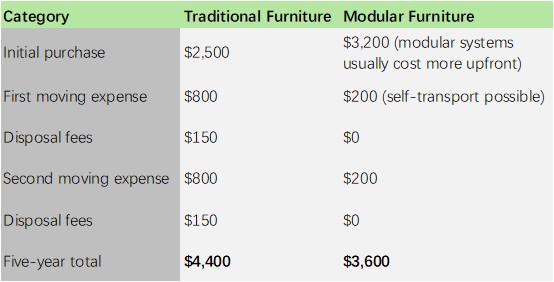
Source: Estimates based on the 2023 moving cost survey by the American Moving & Storage Association and median retail pricing for modular furniture systems.
Conclusion: Over a five-year period, modular furniture can indeed cost less—but the savings do not come from lower purchase prices. They come from reducing the chain costs of repeated moving.
If you do not move during those five years, traditional furniture may still offer better value.
2. Sustainability: Furniture Is a Silent Giant in Landfills
According to the 2024–25 Ohio Statewide Waste Characterization Study conducted by SCS Engineers for the Ohio EPA, furniture and mattresses account for roughly 10% of dumpster volume and 4% of waste weight in mixed disposal streams.
Another study, the 2024 Waste Characterization Study for BMSWD conducted by KCI, found that furniture represented approximately 5% of total public waste volume and 3% of weight.
The problem is not that furniture makes up the largest share of waste. The problem is that it has one of the lowest recycling rates.
Wood, metal, and fabric are fused together in ways that make separation expensive. In many cases, dismantling costs exceed the material value, so most discarded furniture goes directly into landfills.
Modular furniture theoretically reduces waste because damaged modules can be replaced individually rather than discarding the entire piece.
But here again, the outcome is mixed.
Most mainstream modular furniture is still made from particleboard and plastic connectors, materials with low recycling value themselves.
Modularity reduces the tendency to discard furniture during moves, but it does not solve the deeper problem of unrecyclable materials.
The Lesson of Feather: Subscription Models Are Not the Answer
Remember Jay Reno from the beginning of the article?
The furniture subscription company he used was called Feather.
Founded in New York in 2017, Feather allowed customers to pay monthly fees for furniture. During a move, users could return items, exchange them, or purchase them outright.
In 2022, Feather was acquired by Fernish. Soon afterward, the company shut down its consumer subscription business and shifted entirely toward B2B staging services.
What does Feather’s failure tell us?
First: Logistics Costs Destroyed the Economics
Furniture is not clothing. Reverse logistics—collecting, cleaning, repairing, and redistributing furniture—is extremely expensive.
Second: Consumers Still Prefer Ownership
Most people remain uncomfortable with the idea of “renting” deeply personal items such as mattresses and sofas.
Third: Once Capital Tightened, the Model Fell Apart
After the U.S. Federal Reserve raised interest rates in 2022, many direct-to-consumer startups that relied on aggressive funding collapsed. Feather was simply one of them.
The future of modular furniture is probably not subscription-based. It is more likely to become “portable ownership”: you still buy the furniture, but you buy pieces designed to move with you.
Three Signals Worth Watching
1. Compression
Vacuum-compression technology is moving from the clothing industry into furniture manufacturing.
Compressible sofas and mattresses make self-moving physically realistic. Reducing shipping volume by 80% dramatically lowers the psychological barrier to relocating.
2. Open Standards
Some design communities are pushing for open modular interface standards—the furniture equivalent of USB-C.
If shelving systems, tabletops, and support structures from different brands become compatible, modular furniture could evolve into a true ecosystem rather than locking users into one manufacturer.
3. Smart Integration
According to the Smart Furniture Market Size, Share & Industry Analysis, 2025–2034 report by Fortune Business Insights, the smart furniture market is projected to grow from $960 million in 2025 to $3.81 billion by 2034, with a CAGR of 16.78%.
Modular furniture integrated with wireless charging, LED lighting, and embedded technology transforms furniture from passive objects into spatial hardware.
Yet this trend also carries uncertainty.
Technology evolves faster than furniture wears out, meaning “smart modules” may actually accelerate obsolescence.
Conclusion: Your Home Should Not Be Defined by an Address
Modular furniture is not a miracle solution for small apartments, nor is it an environmental silver bullet.
It is a survival strategy for adapting to a reality defined by mobility.
If any of the following describes your lifestyle, modular furniture deserves serious consideration:
- You have moved more than twice within the past five years
- Your leases typically last less than 18 months
- Your living space is under 40 square meters
- Your work allows—or requires—you to relocate between cities
If none of these apply, a durable set of traditional furniture may still be the better choice.
And perhaps the best test is this:
When you imagine your next move, do you feel anxious—or do you think, “It’s fine, I can take everything with me”?
If your furniture makes you afraid of moving, then it may simply be the wrong furniture for your life.
FAQs
1. Is modular furniture only useful for small apartments?
No. Small apartments benefit the most from modular systems because of limited space, but modular furniture is also useful for people who relocate frequently, work remotely, live between cities, or expect major lifestyle changes within a few years.
2. Does modular furniture last as long as traditional furniture?
It depends heavily on materials and construction quality. High-end modular systems made from steel, aluminum, or hardwood can last decades. Lower-cost systems made from particleboard and plastic connectors often degrade faster after repeated assembly and disassembly.
3. Is modular furniture environmentally friendly?
It can reduce waste caused by moving and premature disposal, but environmental impact still depends on materials, manufacturing quality, repairability, and lifespan. A cheaply made modular product discarded after two years may still be less sustainable than a durable traditional piece kept for fifteen years.
4. What type of modular furniture provides the best long-term value?
Generally, the best long-term investments are:
- modular shelving systems,
- expandable storage units,
- adaptable workstations,
- portable seating systems with replaceable covers or cushions.
These products tend to survive multiple moves better than highly mechanical transformable furniture.
5. Can modular furniture work for families with children?
Yes, but safety matters. Lightweight movable systems may tip over more easily than traditional furniture. Families with children or pets should pay close attention to stability, wall anchoring requirements, and material durability.
6. Why are younger generations more interested in modular living?
Economic instability, rising housing costs, remote work, delayed homeownership, and increased geographic mobility all contribute. Many younger adults no longer expect to stay in one apartment or city for long periods, which changes how they think about ownership itself.
References
1. U.S. Census Bureau. (2022). Current Population Survey (CPS) – Geographical Mobility Tables.
2. National Association of Realtors. (2023). Home Buyer and Seller Generational Trends Report.
3. Eurostat. (2024). Youth Statistics – Living Conditions: Age of Young People Leaving Their Parental Household (yth_demo_030). EU-27 aggregate data.
4. MBO Partners. (2024). The 2024 State of Independence in America. Sample: Survey of independent workers and digital nomads in the U.S.
5. Nomad List. (2024). Fastest Growing Remote Work Hubs of 2024.
6. Cognitive Market Research. (2024). Global Modular Furniture Market Analysis from 2022 to 2034.
7. SCS Engineers. (2025). 2024–25 Ohio Statewide Waste Characterization Study – Final Report. Commissioned by Ohio EPA.
8. American Moving & Storage Association. (2023). Industry Cost Survey. Average interstate and intrastate moving cost estimates.
About the Author
Nathaniel Brooks, BSc – Home Ecology Analyst & Sustainable Living Research Writer
Nathaniel Brooks is a home ecology analyst and independent writer specializing in indoor ecosystems, sustainable household practices, and environmental behavior research. He holds a degree in Environmental Science from the University of Edinburgh and has worked alongside urban agriculture programs, green building consultants, and educational sustainability platforms. His articles combine scientific research with practical observations to help readers create healthier, more resilient homes and gardening spaces.
Editorial Transparency Statement
This article was developed using publicly available housing data, mobility reports, market research studies, waste management analyses, and documented consumer case studies published between 2022 and 2026. The goal of this article is to provide long-form educational analysis rather than product promotion.
No furniture brands, rental platforms, or commercial manufacturers paid for placement within this article. Any companies, systems, or products mentioned are included strictly for contextual or analytical purposes.
Cost estimates, moving scenarios, and total ownership comparisons are illustrative models based on available industry averages and may vary depending on region, product quality, and individual living situations.
Disclaimer
This article is intended for informational and educational purposes only. Housing costs, rental regulations, moving expenses, furniture durability, and environmental impacts may vary significantly by country, city, landlord policies, and personal usage patterns.
Readers should independently verify product specifications, lease restrictions, installation requirements, and transportation costs before making purchasing or relocation decisions. References to specific products, brands, or market trends do not constitute endorsements or guarantees of performance.
Recommend for you:
When You Design a Child’s Space, You Design Their Behavior
Why So Much “Children’s Furniture” Fails in Real Homes
The “Invisible Hazards” in Your Home: It’s Not Just Formaldehyde
The “Invisible Hazards” in Your Home: It’s Not Just Formaldehyde
The Rise of Modular Furniture for Short-Term Urban Living
The Furniture Dilemma of Urban Nomads: Is Modularity a Solution, or Just Another Compromise?
Home Privacy in 2026: Balancing Open Spaces and Digital Surveillance
We tore down physical walls, only to weave a digital net inside our homes.