Edible Microgreens 2.0: Indoor Nutrition Trends You Haven’t Tried
By Oliver Hayes | Updated on: April 2026 | 🕓 15 minutes
Key Highlights
- What makes microgreens different from sprouts in terms of safety?
- Which microgreens varieties offer the highest nutrient concentrations?
- How do light spectrum, temperature, and watering affect microgreens’ nutrient density?
- What are the best methods for post-harvest storage to extend shelf life?
- How can home growers implement continuous production and succession planting?
- What are the common causes of microgreens failure and how can they be prevented?
- What is the realistic cost of home microgreens cultivation in terms of electricity, seeds, and substrate?
Social media is flooded with images of neatly lined-up seedling trays on windowsills, bright green shoots, and captions like “Harvest superfoods in seven days.” This narrative reduces microgreens to a “just add soil and water” lazy-gardening trend. In reality, after consecutively ruining four trays of sunflower microgreens in the winter of 2023, I realized that microgreens cultivation is about precise timing, environmental control, and post-harvest management—not some urban pastoral fantasy.
According to the U.S. Bureau of Labor Statistics (2024), the first-year failure rate for an average small business in the United States is 21.5%. Educational resources in the microgreens industry often cite that nearly 50% of new businesses fail within the first year. This is equally relevant for home growers: if you plan to rely on microgreens as a daily nutrition source, “stable yield” is a problem you must solve. Growing them only to have them spoil, go uneaten, or be of such poor quality that you don’t want to eat them is fundamentally the same failure pattern as commercial growers “not being able to sell their crops.”
Redefining Microgreens: Not “Mini Vegetables,” but “Nutrient Concentrates”
In 2012, the U.S. Department of Agriculture’s Agricultural Research Service, in collaboration with the University of Maryland, published a foundational study in the Journal of Agricultural and Food Chemistry. The research team analyzed 25 commercially grown microgreen varieties, measuring their content of vitamin C, vitamin E, vitamin K, and carotenoids. The results surprised even the researchers themselves—some varieties had nutrient concentrations 4 to 40 times higher than their mature vegetable counterparts. Specifically, red cabbage microgreens contained six times the vitamin C of mature red cabbage and 69 times the vitamin K; cilantro microgreens had the highest carotenoid concentration among all tested varieties; and garnet amaranth microgreens led in vitamin K levels.
But here is a critical uncertainty: the same study found that cultivation methods significantly alter nutrient density. In follow-up studies, compost-grown broccoli microgreens had mineral content 1.73 times higher than mature broccoli (sample: 15 experimental replicates), but hydroponically grown (water-only, no nutrient solution) broccoli microgreens only reached 0.86 times the nutrient level—lower than the mature vegetable. The notion that “microgreens are more nutritious” is not unconditional; it depends on how you grow them.
Another overlooked variable is variety selection. In 2024, testing by MP Seeds (sample: 20+ varieties under white, blue, and red LED light) found that different varieties respond very differently to light spectra: red cabbage’s anthocyanin levels surged under blue light, while pea shoots achieved maximum biomass under red light. There is no “universal spectrum” suitable for all varieties.
The Safety Boundary Between Microgreens and Sprouts
Sprouts grow in a closed, high-humidity environment for 2–5 days, and the entire plant (including seeds and roots) is consumed. They have been historically linked to multiple E. coli and Salmonella outbreaks. The FDA has specific regulations for sprout production (21 CFR Part 112 Subpart M).
Microgreens, however, grow in an open medium for 7–21 days, consuming only the stems and leaves. Adequate light and ventilation significantly reduce bacterial risks. The FDA currently classifies microgreens under general produce safety rules but explicitly recommends that growers refer to sprout safety guidelines (FDA, Produce Safety Rule, 81 FR 57784). In March 2025, the FDA issued warning letters to two sprout companies after detecting Listeria monocytogenes, reminding us that the food safety red line for raw crops has never been relaxed.
Advanced Varieties: Why I Only Grow “High-Market-Value” Microgreens
Most beginner guides recommend radish, broccoli, and peas—they are indeed easy to grow. But the logic of Microgreens 2.0 is: if a microgreen sells for a high price in supermarkets and your own marginal cost is near zero, its cultivation value far exceeds simply being “easy to grow.”
Here are five varieties that command real premium prices in the global culinary market but remain niche among home growers:
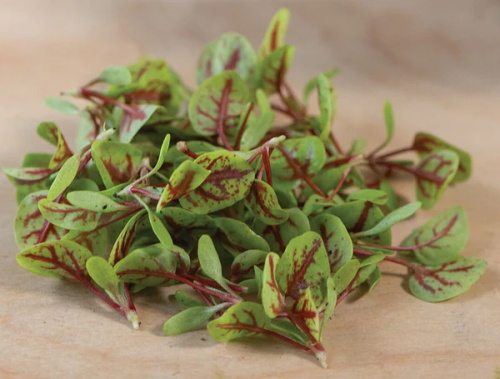
Red Veined Sorrel: Lemon-acid taste with visual impact, commonly used in high-end restaurants in London and New York as garnish for fish dishes. Home-growing cycle: 14–21 days; seed price: roughly three times that of regular radish seeds, but the “restaurant replication value” is extremely high.
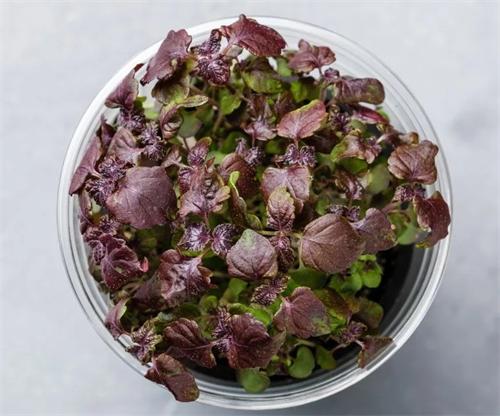
Shiso/Perilla: Irreplaceable in Japanese and Korean cuisine. Shiso seeds historically had low germination rates—a cold soak (5°C water for 24 hours) can improve germination from 60% to over 85%. This is an irreplicable experience from East Asian growing communities: mimicking the winter-to-spring transition that seeds experience in nature.
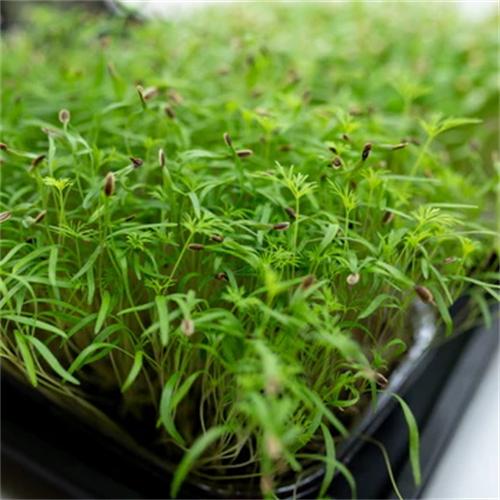
Fennel: Slightly sweet with a licorice aroma, classic pairing with Mediterranean fish dishes. Wholesale prices of fennel microgreens in Europe are typically 30–50% higher than radish.
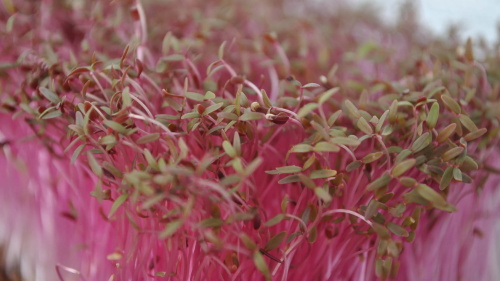
Amaranth: Red microgreens taste nutty and are drought-tolerant. Caution—its stem is very thin, and during dark periods (“blackout period”), excessive pressure can cause the “spaghetti syndrome”: stems twist horizontally and never recover upright growth. I experienced this in spring 2024; switching to a “black-cover method” (cover without applying pressure) solved the problem.
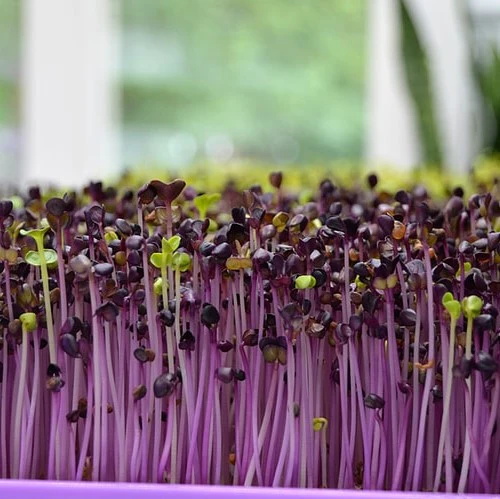
Purple Basil: High in anthocyanins but extremely delicate. According to community experience, basil microgreens have the highest risk of damping-off disease—slow growth (12–16 days), high humidity requirements, extremely sensitive to overwatering. Not recommended for beginners.
Environmental Manipulation: Three “Low-Cost” Ways to Boost Nutrient Density
1. Light Spectrum “Red-Shift Harvest”
A 2023 study in Frontiers in Plant Science tested three LED recipes on two radish varieties (green daikon and rioja improved). The optimal combination for biomass accumulation was 40% blue + 20% green + 40% red. Further, adding UV-A and far-red light before harvest significantly increased anthocyanin concentration.
Home implementation: if your LED strip is only white light, place a red transparent film (or inexpensive red LED strip) 48 hours before harvest to increase red light proportion. It’s not precise science, but it works directionally. A 2024 Flutronix study found that 24-hour continuous light at 450 µmol/m²/s photosynthetically active radiation significantly enhanced mustard-family microgreens’ anthocyanins and flavonoids—but total chlorophyll decreased, and plants experienced mild oxidative stress.
A 2025 study from the Lithuanian Research Centre for Agriculture and Forestry (Horticulturae) provided another perspective: under 250 µmol/m²/s light, a 88.9% red:11.1% blue spectrum produced the highest sugar content in amaranth and mustard microgreens, balancing sugar accumulation and reduced post-harvest deterioration. Notably, providing light during storage (instead of darkness) significantly extended shelf life—contrary to conventional “avoid light” recommendations.
2. Cold Stress
Reducing temperature to 15–16°C for two days before harvest can concentrate glucosinolates in radish and kale microgreens. These compounds are plant defense metabolites, induced by mild cold. Caution: this is “light stress,” not freezing. Temperatures below 10°C will damage seedlings.
3. Mild Drought
Reducing watering frequency for sunflower microgreens on days 8–10 (from daily to every other day) induces anthocyanin production, producing red-stemmed variants and intensifying nutty flavor. The timing is extremely narrow—one extra day of drought can irreversibly wilt plants.
Post-Harvest Storage: The Paper Towel Rule
Microgreens’ high value is built on freshness, but shelf life is inherently limited.
According to a 2024 review in the Journal of Agricultural and Food Chemistry, microgreens last only 2–3 days at room temperature, and up to 14 days at ~4°C. Platforms like Bootstrap Farmer and On The Grow agree:
- Storage temperature: 35–40°F (1.7–4.4°C)
- Storage method: unwashed (do not wash!), place in a container with a lid, layers of dry paper towels to absorb condensation
- Expected shelf life: delicate varieties (like basil) 5–7 days; sturdier varieties (sunflower, peas) up to 14 days
- Exception: basil microgreens sometimes wilt faster in cold storage; some growers find room temperature storage better—controversial practice
On washing: all sources agree—do not wash post-harvest; rinse before consumption. Water is a breeding ground for mold. In my 2024 summer tests, washed microgreens spoiled within three days; unwashed ones lasted up to 10 days.
A 2024 study from the Federal University of Grande do Sul, Brazil (samples: arugula microgreens, three packaging methods, 5°C storage) provided detailed data: vacuum-sealed microgreens started losing quality on day
5, while modified atmosphere packaging (MAP) and open packaging remained edible up to day 10. Open packaging reduced weight loss and chlorophyll degradation—counterintuitive, as most people assume sealing is always better.
Continuous Production System: Two-Tray Succession Calendar
Home growers’ biggest waste is downtime—after harvesting one tray, the next is still germinating, leaving 3–5 days without microgreens.
The solution: succession planting. Using two standard 10"×20" trays as an example:
- Day 1: Sow Tray A (radish, 7-day harvest)
- Day 5: Sow Tray B (sunflower, 10-day harvest)
- Day 8: Harvest Tray A, immediately re-sow (peas, 10-day harvest)
- Day 12: Harvest Tray B, re-sow (radish)
- Repeat
Key tool: labels. Record sowing date and variety. In 2024, I failed to label trays and confused 12-day amaranth with 7-day, resulting in overripe fibrous crops.
Troubleshooting: Mortality Diagnosis Guide (Based on Real Failures)
Damping-Off: caused by Pythium, Fusarium, or Rhizoctonia, triggered in warm (75–80°F/24–27°C) + high humidity (>70%) + poor ventilation. Symptoms: blackened, thinned stems; seedlings collapse. Once it occurs, the tray is lost. Prevention: maintain 40–60% humidity, use a small fan for 24-hour airflow, soak seeds in 3% hydrogen peroxide for 10 minutes.
Root Hairs vs. Mold: about 85% of beginners confuse root hairs with mold. Test: lightly mist the white fuzz—root hairs stick back to the root, mold mats down. Home Microgreens’ community data is based on photo submissions.
Leggy Seedlings: thin stems, yellow leaves. Cause: LED too far (keep 10–15 cm above seedlings) or insufficient light (14–16 hours daily).
Seed Hulls Not Shedding: due to dryness or insufficient pressure during germination. Large seeds (like sunflower) require 3–4 days of tray overlay during dark period to assist hull removal.
Real Home-Growing Costs: Electricity, Seeds, and Time
Microgreens are often promoted as “low-cost, high-return” home projects. But a 2023 lifecycle assessment (LCA) by Parkes et al. in Frontiers in Sustainable Food Systems reveals complexity: global warming potential (GWP) of indoor vertical farms can range 3.3–63.3 kg CO₂e/kg fresh weight—nearly 20x difference. Electricity accounts for 85% of emissions; seeds and trays 32.8%.
For home growers, this means:
Electricity: a 20W LED strip running 16 hours/day consumes ~116.8 kWh/year. In northern Germany, at €0.35/kWh, that’s ~€41/year. In the U.S., cheaper electricity may bring this to $15; in high-cost regions like Japan or the UK, it may double.
Seeds: radish seeds ~€5/100g, sow ~20 trays; shiso seeds ~€15/100g, sow ~15 trays. Two trays/week → annual cost ~€30–50.
Substrate: coco peat bricks ~€3 each, fills ~15 trays → annual cost ~€20.
Total cost: €90–110/year, producing ~100–120 trays → ~€0.9–1.1/tray. Supermarket price: €3–5/tray → marginal cost 1/3–1/5 of market, if you eat them all. A 30% loss from storage or rotation mistakes erodes this advantage.
Non-replicable experience: Living in northern Germany, with ~55% renewable electricity, my kale microgreens’ GWP under optimal 20°C, 24-hour light, high CO₂ was ~24.7 kg CO₂e/kg. Reducing light to 14h/day and temperature to 18°C lowers GWP to ~15 kg, but weekly yield drops from 32.3 kg to ~20 kg. This is a personalized trade-off—no universal answer.
Space & Equipment for Home Growing: Minimum Viable Setup
No dedicated growing room required. My setup: a three-tier 60cm metal rack in a kitchen corner, one tray per tier, occupying <0.5 m². LED strips fixed 15cm above each tray, connected to a timed power strip for automatic daily operation.
Minimum equipment list:
- Seed trays (10"×20", ~€2–3 each, at least 4 for rotation)
- LED strips (20–40W full spectrum, €15–30)
- Timed power strip (€5–10)
- Small fan (USB-powered, €5, for airflow)
- Spray bottle (€3)
- Kitchen paper (for storage, already available)
Total startup cost: ~€30–50—cheaper than a coffee machine, provided you have a suitable corner.
FAQs
Q: Are microgreens safer to eat than sprouts?
A: Generally yes—microgreens grow in open substrate, consume only stems and leaves, and benefit from light and ventilation, reducing bacterial risk. However, following sprout safety guidelines is recommended.
Q: How long do microgreens stay fresh after harvest?
A: Shelf life ranges from 5–14 days depending on variety and storage. Unwashed, refrigerated microgreens last longer than washed ones.
Q: Can any LED light work for growing microgreens?
A: While white LED can work, light spectrum affects growth and nutrient density. Red, blue, and UV supplementation can enhance specific compounds.
Q: Which microgreens are best for beginners?
A: Radish, broccoli, and peas are easier to grow, whereas basil and purple varieties are more delicate and prone to failure.
Q: How can I maintain a continuous supply at home?
A: Use succession planting with at least two trays, track sowing dates, and rotate harvests carefully.
References
1. Shahkoomahally et al. (2025). Effects of light intensity and far-red LED light on broccoli microgreens. Cited in: PeerJ review article (2025). Sample: Multiple light intensity treatments (50-150 µmol m⁻² s⁻¹ PPFD).
2. Silva et al. (2024). Effects of different light spectra on lentil (Lens culinaris) microgreens. Cited in: PeerJ review article (2025).
3. Parkes, S.L., et al. (2023). Life cycle assessment of kale microgreen production under different operational conditions. Frontiers in Sustainable Food Systems. GWP range: 3.3-63.3 kg CO₂e/kg fresh weight.
4. U.S. Food and Drug Administration (2025). Warning Letters: Everything Sprouts, LLC (CMS #699480, March 28, 2025) and Jack & The Green Sprouts, Inc. (CMS #697257, March 19, 2025). FDA Human Foods Program.
5. U.S. Department of Health and Human Services (2015). Produce Safety Rule (81 FR 57784), Food Safety Modernization Act (FSMA). Federal Register.
6. DataM Intelligence (2026). Global Microgreens Market Report. Market size: USD 2.55 billion (2025), projected USD 6.81 billion (2033), CAGR 13.1%.
7. Microgreens World (2024). "Why Most Microgreens Businesses Fail." Industry failure rate estimate: ~50% within first year.
8. On The Grow (2026). Microgreens FAQ: Storage & Harvesting. Shelf life data: 7-14 days depending on variety; basil exception noted.
9. Home Microgreens (2025). "11 Proven Ways to Stop Mold on Microgreens." Root hair vs mold identification: ~85% of submitted photos were root hairs, not mold.
10. Vertical Farm Daily (2026). "How to Prevent Damping Off in Microgreens." Damping off pathogens: Pythium, Fusarium, Rhizoctonia.
11. Hooks et al. (2022). Effect of far-red and/or UV radiation on basil, kale, cabbage, and kohlrabi microgreens. Cited in: Frontiers in Plant Science (2023).
12. Riggio, G.M., et al. (2019). Microgreens food safety considerations. Cited in: Kansas State University repository (K-REx). FDA classification of microgreens under Produce Safety Rule Part 112.
About the Author
Oliver Hayes, MSc – Urban Gardening Systems Researcher & Sustainable Home Writer
Oliver Hayes is a researcher and content writer specializing in urban gardening ecology, balcony food systems, and sustainable home environments. He holds a Master’s degree in Environmental Horticulture from the University of Copenhagen and has collaborated with community garden networks, indoor farming startups, and ecological design organizations across Europe. His work focuses on helping everyday households better understand the hidden environmental factors affecting plant health, indoor biodiversity, and long-term sustainable living practices.
Editorial Transparency Statement
This article is intended to provide accurate and practical guidance based on published research, real-world experience, and community insights in microgreens cultivation. All data referenced (US Bureau of Labor Statistics, USDA, FDA, peer-reviewed journals) is cited with the intent of informing home growers. No commercial product endorsements are included; any brands mentioned serve illustrative or research purposes only.
Disclaimer
The information provided in this article is for educational and informational purposes only. It does not constitute medical, nutritional, or professional advice. Readers should exercise caution when consuming raw produce and follow local food safety guidelines. The author assumes no liability for any loss, injury, or damage arising from the use or misuse of the information contained herein.
Recommend for you:

The Secret Social Lives of Plants
How Plants Influence Ecosystem Power Through Resource Competition, Chemical Warfare, and Underground Networks
Home Privacy in 2026: Balancing Open Spaces and Digital Surveillance
We tore down physical walls, only to weave a digital net inside our homes.
AI Gardening Assistants: Can Robots Actually Save Your Plants?
The training data for mainstream AI plant diagnosis models mostly comes from “standard healthy samples” or “typical disease samples.”
Microbial Ecology in Potting Soil Explains What Care Routines Cannot
Why Identical Balcony Plants Grow Differently Under the Same Water and Light